
Full Tournament Rules:
Competition Judging Quiz (15 Questions)
1. (Fill in the blank)
Judges are responsible for making sure __________ _________, ______________ __________ & Timekeepers know their jobs.
2. (Multiple Choice)
What is the correct scoring range for forms, techniques, and weapons?
A. 1–10
B. 5–10
C. 9.0–10
D. 8.5–10
3. (Short Answer)
When does judging of a competitor begin?
4. (Multiple Choice)
Who breaks a tie first?
A. Scorekeeper
B. Head table
C. Center judge
D. Tournament director
Bonus: what score breaks a tie if the 1st method doesn’t work? Highest _____________________score.
5. (True/False)
Judges may discuss scoring during a competitor’s performance.
6. (Fill in the blank)
Competitors must introduce themselves by saying:
“Hello ___________________________________________________________________________ I begin?”
7. (Multiple Choice)
If a black belt drops their weapon during a form, what happens?
A. Minor deduction
B. Major deduction
C. No score
D. Warning
8. (Short Answer)
Name three key factors judges should evaluate in all performances.
9. (Multiple Choice)
What is the maximum time allowed for a self-defense routine?
A. 30 seconds
B. 45 seconds
C. 1 minute
D. 2 minutes
10. (True/False)
Music is allowed in forms competition.
11. (Fill in the blank)
In sparring, a head kick is worth ______ points.
12. (Multiple Choice)
How many judges must agree for a sparring point to be awarded?
A. 1
B. 2
C. 3
D. All judges
13. (Short Answer)
What are the first three responsibilities of a Center Judge?
14. (Multiple Choice)
What happens after a competitor receives a third warning in sparring?
A. No penalty
B. Lose 1 point
C. Disqualification
D. Restart match
15. (Fill in the blank)
In breaking, each competitor must perform ______ different breaking techniques.
Competition Judging – Duties, Responsibilities, Rules and Procedures
Judge Responsibilities
Attend the Judges Meeting at the time indicated on the Tournament Itinerary. Provide a positive, fair, and non-biased competition experience for all competitors based on performance that day. Be courteous and respectful to competitors, judges, helpers, and spectators. Ensure the safety of all competitors in the ring and surrounding areas, including spectators. Remain in assigned judging areas. Use restrooms between events and notify the Center Judge when needed.
Center Judge Responsibilities
Maintain efficient flow of the ring from one event to the next. Resolve issues or escalate to the Tournament Arbitrator when necessary. Ensure scorekeeper, timekeeper, and side judges understand their roles and assist as needed. Ensure the ring box has all required equipment; obtain additional items from the head table if needed.
Preparation
Ensure all judges and staff understand their responsibilities before competition begins. The head table determines medal placements; judges must not create additional placements without approval. If divisions are combined, competitors perform the material they prepared. Judges must create a positive experience for all competitors. Recognize that belt systems may vary across schools; competitors register according to their school’s guidance and belt equivalency charts.
Scoring
Judges must be fair and consistent. Competitors are judged from the moment they bow into the ring. Key judging factors include execution, balance, coordination, control, speed, power, stable stances, focus, etiquette, and attitude. Scores range from 9.0 to 10 for forms, techniques, and weapons. Judges do not display scores until instructed by the scorekeeper or center judge.
Tie Breaking: The center judge score breaks ties. If still tied, the next highest judge score is used. If still tied, competitors perform again and judges decide by show of hands.
If a competitor does not complete a category, no score is awarded. Exception: Judges may assist young children (age 7 or under, blue belt or lower), who may receive scores between 9.0–9.3.
Judges must not confer during performance; missed sections must be confirmed by at least two judges before deductions are applied.
Etiquette and Uniforms
All judges must demonstrate excellent etiquette at all times. Judges must wear a complete martial arts uniform (jacket, pants, belt, and t-shirt). Competitor introductions are required in all applicable divisions: “Hello Judges, my name is ___, may I begin?” Introductions and receiving scores may be done standing or kneeling without penalty.
General Information
Late competitors may not compete if their division has already started. Competitors typically compete within their belt and age division, but divisions may be combined if necessary. Scorekeeper announces “up,” “on deck,” and “in the hole.” Medals are awarded for 1st through 4th place. Issues should be directed to the head table.
Uniform Requirements
Competitors must wear a complete traditional or sport martial arts uniform in good condition with appropriate belt or sash.
Sparring: Sleeves must reach mid-biceps; no t-shirts, sweats, tank tops, or shoes allowed.
Forms, Weapons, Techniques, Fight Choreography: Uniform jacket, pants, belt/sash, and t-shirt required. Shoes are not permitted.
Competition Divisions and Criteria
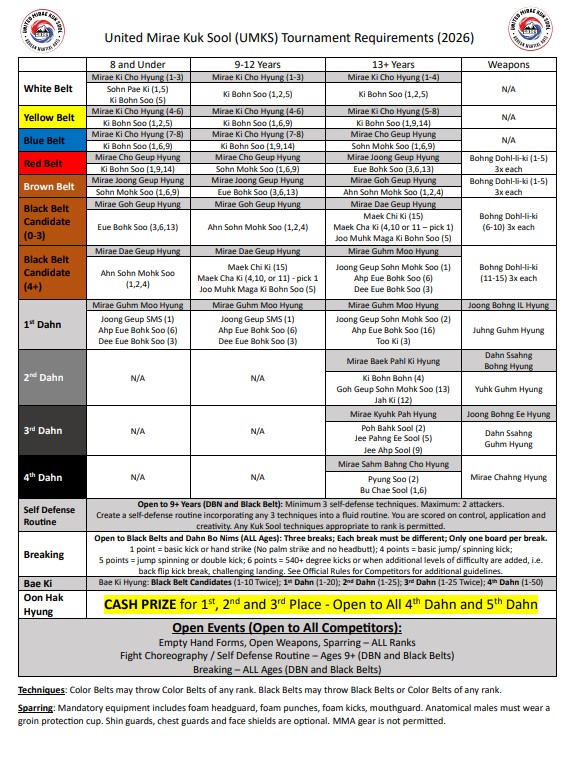
Empty Hand Forms (Open to All Styles)
Forms performed without weapons. Judged on execution, balance, speed, power, stances, and focus. Music is not permitted. Judges should evaluate as if unfamiliar with the form.
Open Weapon Forms (Open to All Styles)
Any martial arts weapon allowed. Judged on control, execution, balance, speed, power, stances, and focus.
Penalties:
- Black belts dropping weapon or not completing form = no score
- Color belts dropping weapon = major deduction
- Weapon hitting ground or body affecting flow = 0.10 deduction
Music not permitted.
Fight Choreography / Self Defense (Ho Shin Sool)
Routine selected by competitor (advanced ranks, age 9+). Must include a minimum of 3 techniques (blocks do not count). Routine must be fluid, controlled, and creative. Maximum 2 partners allowed. Time limit is 45 seconds; scoring based only on first 45 seconds.
Judging factors: application, control, creativity, and flow. Partner actions are not scored.
Allowed props: purse, backpack, scarf, belt, rubber knife, cane. No inappropriate behavior allowed. Music not permitted.
Breaking (Open to All Styles)
Black belts and Dahn Bo Nim only. Competitors select 3 different breaks, one board per break (exceptions apply). Points assigned based on difficulty (basic strikes = 1 point, jump/spin variations up to 6 points). Height requirements apply. One attempt per break. Used boards are discarded. Ties resolved by difficulty or point-off.
Point Sparring (Open to All Styles)
Required equipment includes headgear, hand and foot protection, mouthguard, and groin protection (male). Optional equipment includes shin guards, elbow pads, chest guards, and face shields.
Match duration: 2 minutes or first to a 5-point spread.
Scoring: 2 points for head kicks, 1 point for body strikes. Two judges must agree for a point to count.
Contact levels: light to medium only; excessive contact may result in penalties or disqualification.
Illegal targets: below the belt, back, top of head, face, neck.
Warnings:
- 1st warning: no penalty
- 2nd warning: opponent awarded 1 point
- 3rd warning: disqualification
Championship Divisions
Three categories: Mirae Champion, Open Champion, Oon Hak Hyung Champion.
Medal points: 1st = 6, 2nd = 4, 3rd = 2, 4th = 1.
Ties determined by number of higher placements or judge decision.
Eligibility and required events vary by rank and category.
Mirae Curriculum Requirements
Forms (Hyung)
Must be performed on the regular side. Judged on memory and five principles: focused eyes, controlled hands, precise feet, calm mind, stable stances. Score range 9.0–10. No score if incomplete.
Techniques (Sool Ki)
Performed on regular side in required order. Each technique includes takedown, pin, and finish (exceptions apply). Partners must be similar in size and age. Score range 9.0–10.
Staff and Sword
Weapons must meet specifications (metal Korean-style swords, no live blades; wooden/bamboo staff of correct length). Judges verify proper equipment. Score range 9.0–10.
General Principle
All judging should prioritize fairness, consistency, safety, and a positive competitor experience while maintaining high standards of martial arts performance and etiquette.